ESSAY
The American Spectacle: A Short Manifesto
By Regan Rosburg
July 4, 2026
In 1967, French philosopher Guy Debord wrote what would become one of the most timely and enduring critiques of the modern era: The Society of the Spectacle. He identified two systems of social control. The "concentrated spectacle" is associated with authoritarians and bureaucracies — power centered in a leader, party, or state, enforced through force, surveillance, and propaganda. The "diffuse spectacle" is the version of advanced consumer capitalism — control through the illusion of choice, coercive advertising, endless commodities, and entertainment. Where the concentrated spectacle rules by violence and dominance, the diffuse spectacle rules by desire, seduction, and consumption.
In 1988, Debord had a new claim. America had done something other countries hadn't: it integrated the two systems. The "integrated spectacle" was insidious — the control of the state, the secrecy of elites, media management, and consumer culture, each seamlessly woven into a fabric that bore the stars and stripes.
Debord predicted the spectacle's built-in tendency to advance and intensify, so he would not be surprised by where we've arrived. Its defining feature is the erasure of boundaries — between the real and the fake, the image and the thing it represents, the consumer and the consumed. Society feels free on the surface while being run through with manipulation and control. Examples are everywhere. Voting has not only been hijacked by the slow creep of gerrymandering and the electoral college, but also destabilized by accusations of fraud. Institutions in academia, media, science, and the arts are instructed to act in accordance with political will, lest they lose funding or face litigation. Algorithms dictate, provoke, and/or reinforce our proclivities to maximize engagement. Our preferences, conversations, searches, posts and physical movements are tracked as data points and sold to corporations, who in turn have increasingly merged with governments. People are literally and metaphorically reduced to identities in tiny boxes -- not people with families, lives, and histories.
And while we bicker about what patriotism means, the coffers are robbed, the lands are sold. That is perhaps the most tragic loss of all – the disconnect from seeing ourselves in a shared home, with a shared history in shared air, water and land. Instead, the opiate of our differences estranges us from the natural world that sustains us – and this further estranges us from any stable sense of what is real. For most of us (as we rush to make ends meet), our lives are experienced in sound-bites, lacking context, lacking substance, lacking even true reality. How can one be free to choose when we cannot agree on what is real? Artificial Intelligence provides a fitting emblem: an image of an image of an image, all the way down.
With both this integration of control and entertainment, is it any wonder we have a reality TV president who orchestrates daily life like an episodic drama? After the assassination attempt in Butler, he asked his aides: how did it play out on TV? Meanwhile, former news anchors send troops to battle after receiving the Pulp Fiction gospel. Hurricanes are enlarged with Sharpies, and climate change is refuted by a snowball pulled from a briefcase. Old-growth forests are sold to logging tycoons while elaborate boxing matches on the White House lawn command viewership. Heads of state sit with heads of corporations, who flatter with invented participation trophies and diamond-encrusted rings. It would be darkly funny — if it weren't also tragedy, grief, poverty, corruption, incompetence, racism, sexism, ecological collapse, and control dressed as religion. The roots of this entitlement reach down into the bedrock of the founding.
On this 250th anniversary, we have arrived at what might be called “peak spectacle.” But to critique the madness of today is to critique the systems that made it possible. Born from colonialism, genocide, and environmental destruction, the American experiment has always been two arguing parents: one is the idea of freedom, equality, and justice — the other is the reality of control, inequality, and injustice. Their offspring took its first steps in Europe, spilled some tea in Boston Harbor, crawled across the rug of Manifest Destiny, walked straight through the Gilded Age, butted up against the George Floyd uprisings, then scaled the walls of Congress and defecated on Nancy Pelosi's desk.
Perhaps a spectacle at its zenith collapses under its own absurdity — glaring truths revealed, like cheap gilding chipping off a statue. Debord warned that to critique the spectacle was to risk becoming part of it. But he also believed in the power of art to provoke conversation, emotion, and action – and to that end, he sparked a legacy of “detournement”… recontextualizing known icons in a way that subverted the original meaning. Something like a gilded flag, for example, might point to an elitist class ruling over a nation by pushing an erasure of its darker, complicated history instead of a shiny, more soothing mythology -- one that lacks not only the complexity, but the founding cruelty, separation, and subjugation.
The “New Gilded Age,” a repeated refrain by those in power, is no accident. It is a dog whistle to the wealthiest people on earth to repeat a plundering of resources – but this time, without philanthropy nor shame.
The resources are not limited to being on, underneath, or running through the United States’ soil.
The resources are our collective air, rivers, rainfall, aquifers, harvests, soils, burial lands, trees, plants, animals, dark skies, and ocean waters.
The resources are our time, attention, autonomy, and our very thoughts.
The resources are our right to vote, our right to free speech, our right to assemble, our right to defend ourselves from an authoritarian government, our right to have agency over our own bodies, our right to pray to a God of our choosing -- and to love who we want to love.
The resources are the resolve to face and rectify our complicated, imperfect past and to imagine and implement a vision of a better future.
The New Gilded Age is the American Spectacle – a thin layer of patriotism masking greed, dysfunction, corruption, and contempt for basic human rights. Debord urged a radical return to presence — to direct, unmediated experience. The spectacle cannot function without desire, division, confusion, and distraction. To give one's full attention to one's actual life – witnessing reality and not flinching-- is, therefore, an act of resistance.
Happy Birthday, America.
Now get your shit together.
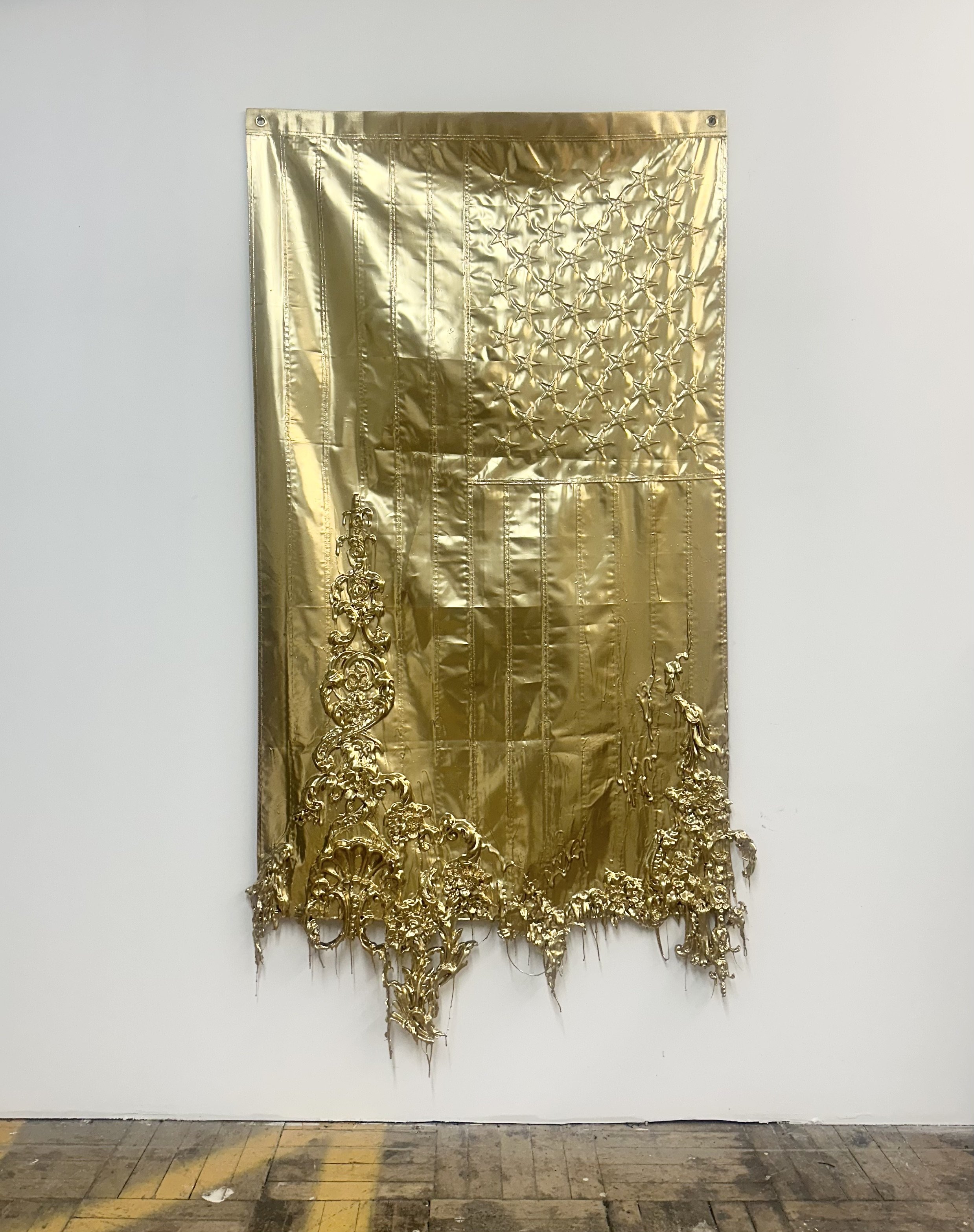
My own morality, my own mind. It’s the only thing that can stop me. -Donald Trump, January 2026.
Mixed-media painting (spray paint on cheap, poorly stored US flag, plastic, resin)
36 x 55 inches, 2026
In the early weeks of January 2026, the Trump administration kidnapped the president of Venezuela, threatened to invade Greenland, and turned a blind eye when US citizens were shot in MN for exercising their First, Second, and Fourth Amendment rights. Around the same time, on Air Force One, a journalist asked him about international law. The president conveyed that he (and presumably the USA) is not beholden to international law. The journalist pressed him and asked what could stop him, to which he responded, "My own morality, my own mind. It's the only thing that can stop me."